Case study · LABAQ
From zero to a brewing platform in five months
LABAQ brings together Quebec's amateur brewers. When the association handed us its file in April 2026, its website had just been deleted by its host and nothing was left. Five months later, it has a complete platform, and we fully recoded it along the way.
Nothing was left
The association already had a WordPress website, built by volunteers and hosted with a large foreign provider, with no maintenance contract. One unpaid invoice was enough: the provider closed the account and deleted what it held — the website, the database and the backups all at once.
So there was nothing to take over. No content, no copy, no export. The job wasn't to redo a website, it was to start from scratch.
It's a common scenario in volunteer organizations, where access to hosting often follows the person who opened the account. The real question, for any organization: if your website disappeared tonight, what would you have left tomorrow morning?
Since then, the LABAQ website has been hosted in Quebec on infrastructure we administer, and backed up every night to an encrypted archive: thirty days of retention, plus twelve months of monthly archives. It isn't an option in the plan. It's the baseline.
Why we recoded everything five months later
The April version relied on a page builder. It's the tool that gets an association back online quickly without blowing its budget, and it was the right choice that spring.
As the association added its courses, recipes and members, the limits arrived. The home page loaded 2.2 MB and twenty-six scripts, several of which no page used. Above all, every piece of content was frozen in blocks that had to be edited one by one, and the figures displayed had to be rewritten by hand.
In September, we recoded everything. Not touched up: recoded. The templates became versioned code instead of stacked blocks, and the website could open up to what a page builder doesn't allow.
We say it frankly, because that's where the real craft lies: knowing how to launch fast with the simple tool, recognizing the moment it's no longer enough, and being able to write what comes next. Most providers only do one of the two.
What we built
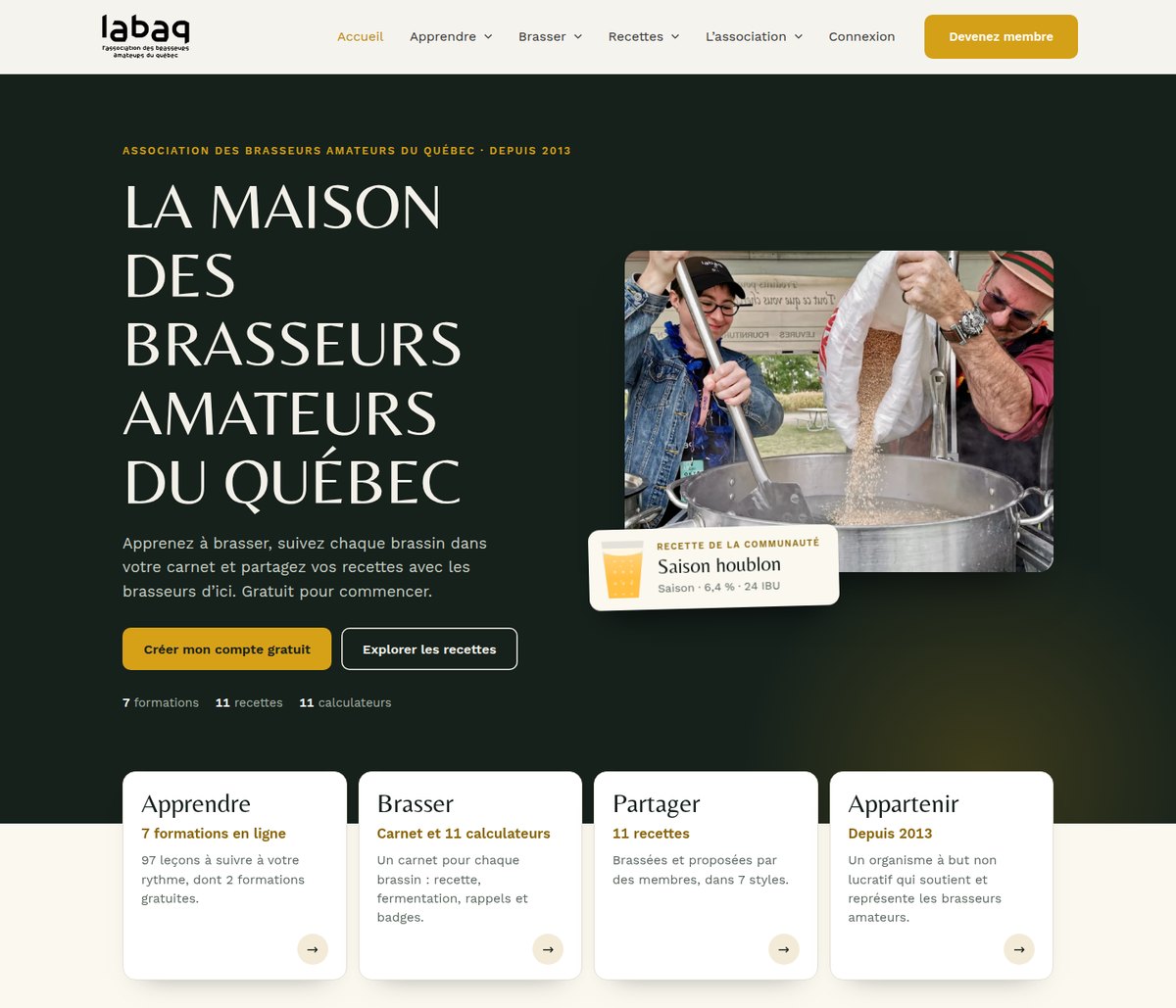
The website
Home page rebuilt in nine sections, menu reorganized into four doors, full footer. One principle held from start to finish: no figure is written by hand. Everything the page announces is read live from the website. A counter can no longer lie, because nobody writes it anymore.
The brewing log
The centrepiece. Members record their brews and register their equipment — the website then adapts recipes to their volumes and efficiency — enter their gravity readings and watch their fermentation curve take shape.
Brew-day mode is a standalone document: dark background, large type, sound timers, the screen stays on, and if the phone locks the session picks up where it left off. It's meant to be read in a garage, with one free hand.
The tools
The eleven calculators stay together on a single page, as members wanted. Eleven individual pages were added on top, each with its formula, a worked example and its benchmarks. Both versions share exactly the same code: a formula fixed in one place is fixed in both.
The content
Six guides on subjects only Quebec can write about: brewing in a Quebec winter, maple beer, local hops. The one about the law is drawn from the official texts of the Éditeur officiel du Québec, and every statement cites its section.
The members
Recipes submitted by members go through the board's approval workflow before entering the library. And twenty-six memberships left open on the old system were taken over one by one, without any member having to pay again.
The hydrometer that writes in the log by itself
A Tilt is a floating hydrometer: it measures gravity and temperature inside the fermenter and broadcasts them over Bluetooth. The big brewing platforms know how to receive them. Now, so does the LABAQ website.
Members copy their personal address into the app, attach the device to a brew, and that's it: readings arrive every fifteen minutes and the curve fills itself in. Two readings per day are kept — gravity, average temperature, its minimum and maximum — because a log you can read beats a series of thousands of points.
No third-party service in the chain, no subscription to a foreign platform. The device talks directly to the association's website, and the readings stay with the association.
The technical choices that concern you too
- No third-party service, no external script. Everything that runs the website lives on the website’s own server.
- No advertising tracker, no audience measurement. It's a decision, not an oversight.
- Law 25 applied: explicit consent, mandatory pseudonym for public profiles, data export and deletion on request, automatic deletion after twenty-four months of inactivity.
- Hosted in Quebec, on infrastructure we administer.
- Backed up every night, to an encrypted archive, with thirty days of retention and twelve months of monthly archives.
- Every release is reversible. Every new feature arrives behind a switch: if it doesn’t please, we roll back in seconds, without redeploying.
These choices aren't specific to an association's website: they apply as is to an SMB, and our prices are published in advance.
Where things stand
The website now has thirty published pages, eleven calculators each paired with its own page, six guides, a recipe library fed by members, and a brewing log open to all.
We won't publish a traffic growth percentage. The LABAQ website deliberately has no audience measurement: it was a requirement of the engagement, and we won't invent figures after the fact that we chose not to collect. What we can show is what exists and works. The address is public: go and see.
Do you have a project like this?
Tell us what your website needs to do. We’ll tell you which option fits, and what it costs.